Press Release: FFJC Launches National Initiative to Help Courts Improve Fine and Fee Practices
Contact:
Michael Paul Jackson, Fines and Fees Justice Center
mjackson@finesandfeesjusticecenter.org
The Court Engagement Initiative helps judges hold people accountable effectively, efficiently and fairly – creating safer and stronger communities.
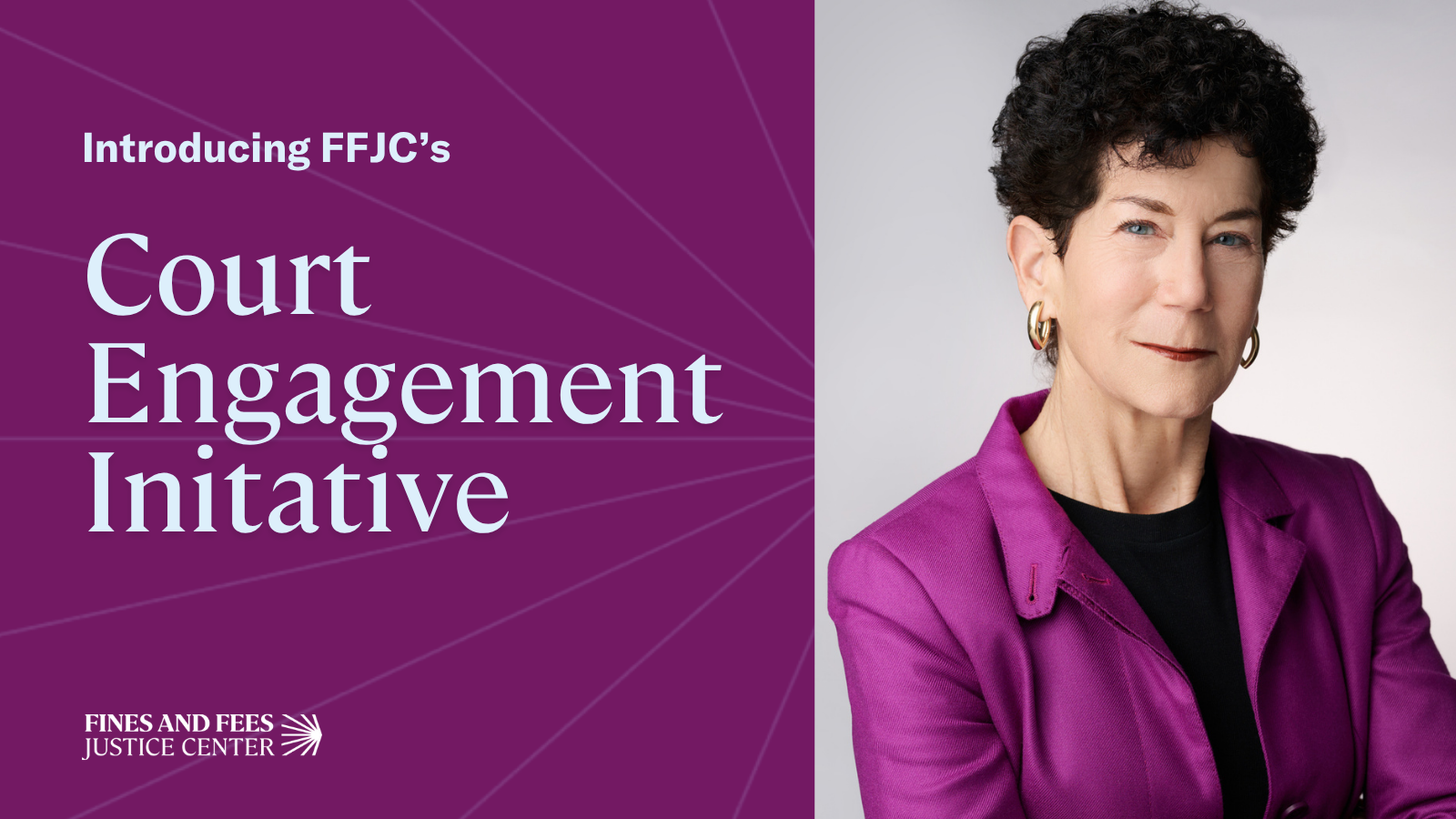
NEW YORK – Today, Fines and Fees Justice Center (FFJC) formally launched its new Court Engagement Initiative (CEI), a nationwide project to work with judges, court administrators, prosecutors, and public defenders interested in improving their jurisdiction’s fine and fee practices.
Led by FFJC’s Co-Founder and Senior Advisor Judge Lisa Foster (ret.). CEI provides free education, training, and technical assistance to judges and other justice system stakeholders on how best to hold people accountable without imposing excessive fines and fees.
Across the country, a growing number of courts are changing their fine and fee practices, recognizing that they are ineffective and costly – for individuals, families, communities and the courts.
“The justice system is supposed to keep our communities safe and strong by holding people accountable when they violate the law,” Judge Foster said. Imposing fines and fees that a person cannot afford to pay undermines those goals. CEI works with judges and other court actors to understand the impacts of unaffordable fines and fees, learn best practices, and devise effective solutions.”
From parking tickets and traffic violations to more serious charges, fines are the most common sanction imposed in the United States today. In addition to fines, fees, costs and other assessments are also charged, and they are often more costly than the fine itself. Together, these sanctions can force families to make impossible choices between paying their court debt or providing food, housing, health care or other necessities for themselves and their families.
CEI’s educational programs are designed to meet courts where they are, whether providing general education on fines and fees, sharing best practices, or conducting in-depth training for courts implementing new ability to pay procedures. The programs are tailored to each jurisdiction and include statutory and Constitutional provisions that govern fines and fees and the latest research on the impact and efficacy of ability to pay assessments.
CEI’s one-on-one technical assistance is available to judges or courts to develop tailored ability to pay procedures, forms and bench cards to help courts determine whether to waive or reduce fines and fees or impose alternative sanctions.
Research shows that when fines and fees are set at amounts people can afford, compliance rates increase. For example, in Texas, after courts implemented ability-to-pay assessments in 2017, the amount of fines and fees imposed decreased, but collections increased by nearly seven percent. Research also shows that when fines and fees are affordable, people pay quickly and in full.
Before its formal launch today, the Initiative provided education or training in Mississippi, Colorado, Montana, New Hampshire, Kansas, Missouri and California; and provided technical assistance to twelve jurisdictions in ten states.
“Lisa provided training for both our District Court judges and our Municipal Court judges and worked with the Supreme Court to develop an ability to pay bench card for all our judges to use. She was engaging, respectful of our laws and practices and received excellent reviews, ” said Justice Laurie McKinnon of the Montana Supreme Court.
The Court Engagement Initiative also works with judges interested in advocating for fine and fee reform at the local and state level through court rule change, legislation or local practice.
For more information about the Initiative, visit our website or reach out to Judge Foster directly, lfoster@finesandfeesjusticecenter.org.
###
Recommended Articles
Co-Founder and Co-Executive Director Joanna Weiss Stepping Down as Executive Director of FFJC