Press Release: The Fines and Fees Justice Center Releases First-of-its-Kind Report Showing Billions in Relief to Families from Reforms
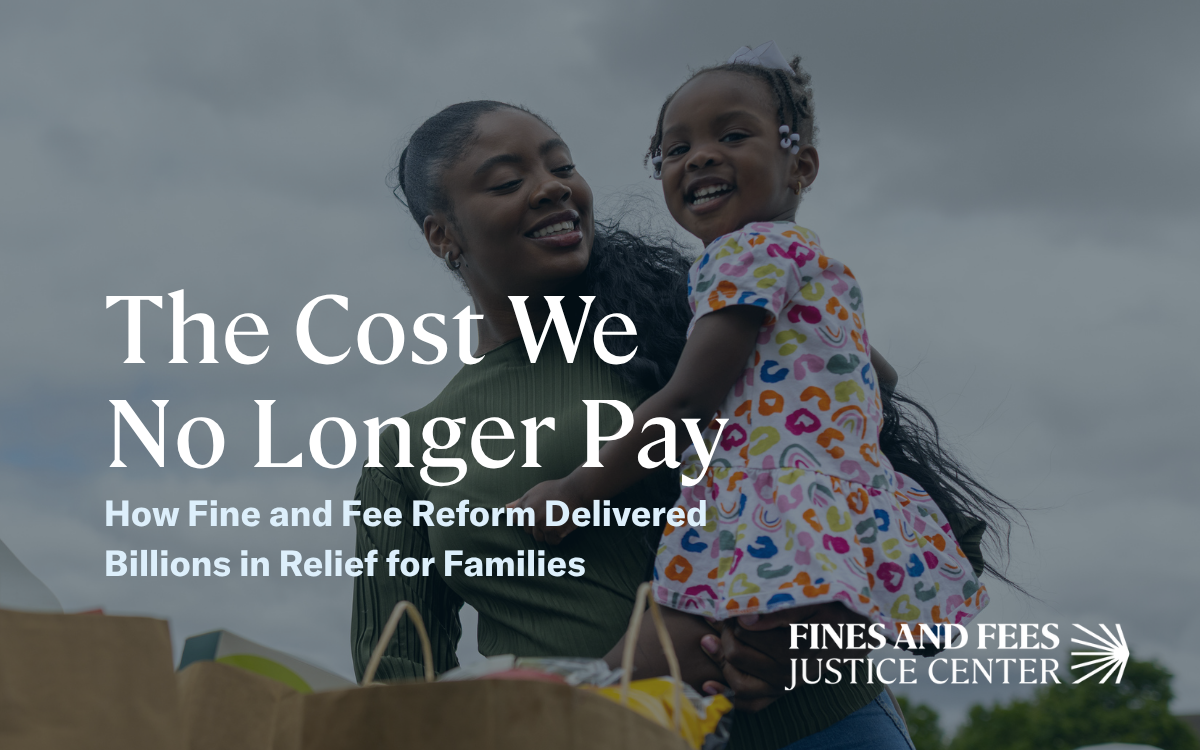
The Cost We No Longer Pay shows how families and communities across the country have significantly benefited from fines and fee reform since 2018
FOR IMMEDIATE RELEASE
April 28, 2026
Contact:
Michael Paul Jackson, mjackson@finesandfeesjusticecenter.org
NEW YORK – Today, Fines and Fees Justice Center (FFJC) released The Cost We No Longer Pay, a report detailing the overwhelming amount of financial relief that has been brought back to families and communities through the work of FFJC and its partners, resulting in more than 70 separate pieces of legislation reforming fine and fee policies since 2018.
Based on our research, we conservatively estimate at least $37.5 billion delivered in financial relief – money that people can now spend to support themselves, their families and contribute to their communities. For context, $37.5 billion alone is enough to pay for a full year of groceries for roughly 3.1 million families—enough to feed every household in Los Angeles, Atlanta, San Antonio, Charlotte and Jacksonville, Florida combined.
The 71-page report comes after more than two years of extensive, meticulous research and data collection designed to quantify, for the first time, what fine and fee reform really means for people. It demonstrates what can be done when a broad coalition of advocates and bipartisan legislators work together to create fines and fees reform – not just to help families and communities, but to create better economic policy for state governments.
“Our first priority in measuring the impact of our work is to study how it has changed the lives of families facing fines and fees,” said Joanna Weiss, FFJC’s co-founder and co-executive director. “Families can use these savings toward heating their homes, paying their rent and putting food on the table. But make no mistake, the savings created by fines and fees reform reverberate into the broader economy, creating safer, more resilient communities, and smarter, sustainable policy.”
Our criminal justice system historically imposes fines and fees in an attempt to generate revenue for state and local governments – often on the backs of people that can least afford to pay. Saddled with mounting debt, people and families can face severe consequences for nonpayment, including driver’s license suspensions, arrest, and jail. Anyone who misses just one payment can be trapped in an endless cycle of debt and punishment.
Fines and fees also disproportionately impact communities of color, deepening already damaging racial disparities, erecting barriers to opportunity and undermining the financial health, wealth and security of our communities.
“More than ten years after the U.S. Department of Justice’s report on the City of Ferguson’s use of fines and fees to prop up police and courts at the expense of marginalized communities, our report shows that progress has been made in eliminating these unjust and discriminatory governmental practices, but the work is just getting started,” said Priya Sarathy Jones, FFJC’s co-executive director. “At a time when so many of us are struggling with affordability costs, this report shows how much money can be kept with families through advocating for smart and impactful legislation.”
This report estimates relief drawn from nearly every element of fines and fees reform, including:
- $15.1 billion in earnings regained when people’s driver’s licenses are reinstated
- $84 million in fees that no longer have to be paid
- $2.6 billion in outstanding fine and fee debt discharge.
- $431 million in driver’s license reinstatement fees waived and;
- $34 million in new reinstatement fees prevented annually.
Fines and fees impact more people than any other issue in the criminal justice system. In a 2023 national survey, one in three people reported that they owed fines and fees in the previous ten years, and nearly every affected person reported that court debt impacted their daily lives. In addition, 17 million households with children have had to cut back on at least one basic need—like food, housing, or healthcare—because of court debt.
And because so many cannot afford to pay these debts, governments often fail to produce enough revenue to balance their budgets, proving fines and fees as an ineffective and counterproductive way to raise revenue.
“Working to eliminate criminal justice fees reduces the economic burden on people who’ve already paid their debt to society and helps them focus on rebuilding their lives,” said Representative Tammy West of Oklahoma. “Reducing reliance on uncollectible debt is smart governance that strengthens the integrity and fairness of our courts.”
The Fines and Fees Justice Center is leading the movement to eliminate the fines and fees that distort justice. In addition to working in our focus states, New York, Nevada and New Mexico, and in many localities, FFJC works on national reforms with two national, bipartisan campaigns, Free to Drive, and End Justice Fees. Our mission is to eliminate fees in the justice system, ensure that any fines are equitably imposed and enforced, and end abusive collection practices.
The report also highlights the lived experiences of the people impacted by harmful fines and fees; men and women like Teon S., an Alabama mother who had her driver’s license suspended for six years, all from the snowballing cost of a single ticket she received for an incorrectly-sized booster seat.
Unable to drive, her children missed doctor appointments, and she was forced to walk miles to get groceries for her family. Indeed, Teon’s lived experiences and those of the others featured in the report are clear examples of a cruel and counterproductive practice.
“I stopped driving out of fear,” Teon said. “My children missed doctors appointments and dentist appointments. We would walk miles to get groceries. All because I was afraid of getting pulled over and getting another ticket.”
Read and download the full report here.
###
Recommended Articles
Co-Founder and Co-Executive Director Joanna Weiss Stepping Down as Executive Director of FFJC